Millions of animals are currently in shelters and foster homes awaiting adoption. Design an experience that will help connect people looking for a new pet with the right companion for them.
Help an adopter find a pet which matches their lifestyle, considering factors including breed, gender, age, temperament, and health status. Provide a high-level flow and supporting wire frames.

According to NCBI, more than 200K lost or abandoned dogs end up in rescue shelters every year in Australia. Unfortunately, less than a third of these animals find a new home and more than 40K are euthanized yearly.
Among many factors that contribute to the large number of abandoned animals found today, general misconceptions about rescue dogs behaviours and the large number of unregulated puppy farms constantly breeding too many animals are significantly adding numbers to these statistics.
Sources:
RSPCA Australia Annual Statistics
NCBI Surrendered and Stray Dogs in Australia
TSMH Truth about cats and dogs: 250,000 killed every year
In order to get deeper understanding about the issue I wanted meet and speak with those who are significantly involved with the animal rescue and adoption process: Animal shelters and adopters.
With that in mind, I’ve contacted two of the major animal shelters in Sydney (Sutherland Shire Animal Shelter and Sydney Dogs and Cats Home) and I was allowed to spend a few hours observing and talking to potential adopters, as well as interviewing some of their staff.
I’ve had the chance to interview a total of 4 shelter staff members and 5 potential adopters, I’ll summarise the most relevant learnings I took away from these interviews in the next section.
“Adopting an animal is a complex activity. Adopters must consider a wide range of factors before they can safely commit to adopting an animal.”
“People come in, then they realise that the dog is a mismatch.”
“Assessing adopters is a key factor for the success of a good match, but each organisation has their own adoption policy.”
- SDACH Matching Form
There’s information everywhere and it takes a lot of time and effort to search in multiple websites.
Adopters have some dogs qualities in mind when looking for on a dog.
There is a considerable level of competition and acting fast when finding a dog is very important.
Wooofff wooofff woooffff...
Based on what I’ve learned from shelters and adopters, I defined a family persona to be referred to throughout the rest of the design process, as well as a story representing the ‘Adopters Hero Journey’. This artifacts help to synthesize and communicate the context of the problem.
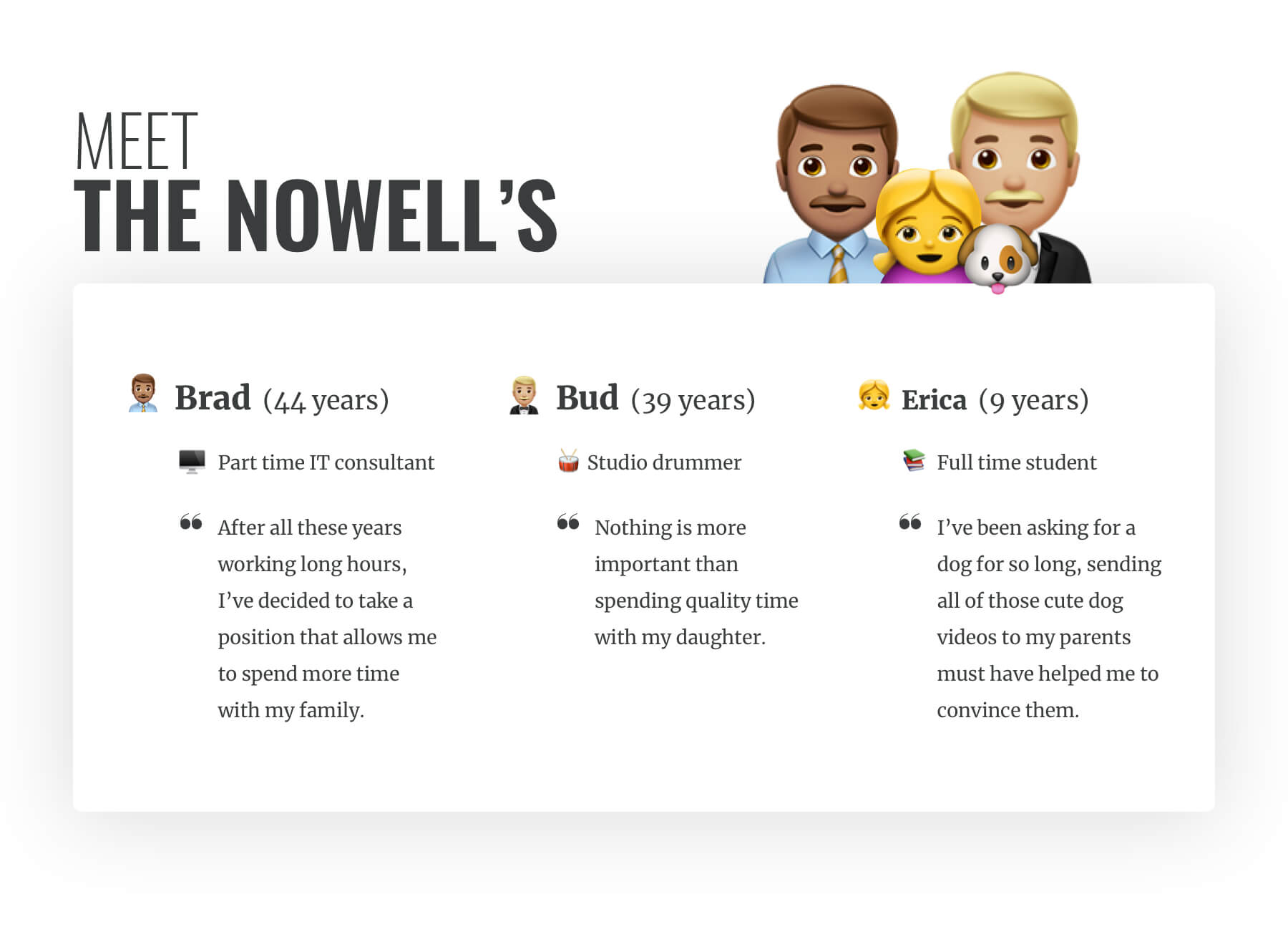
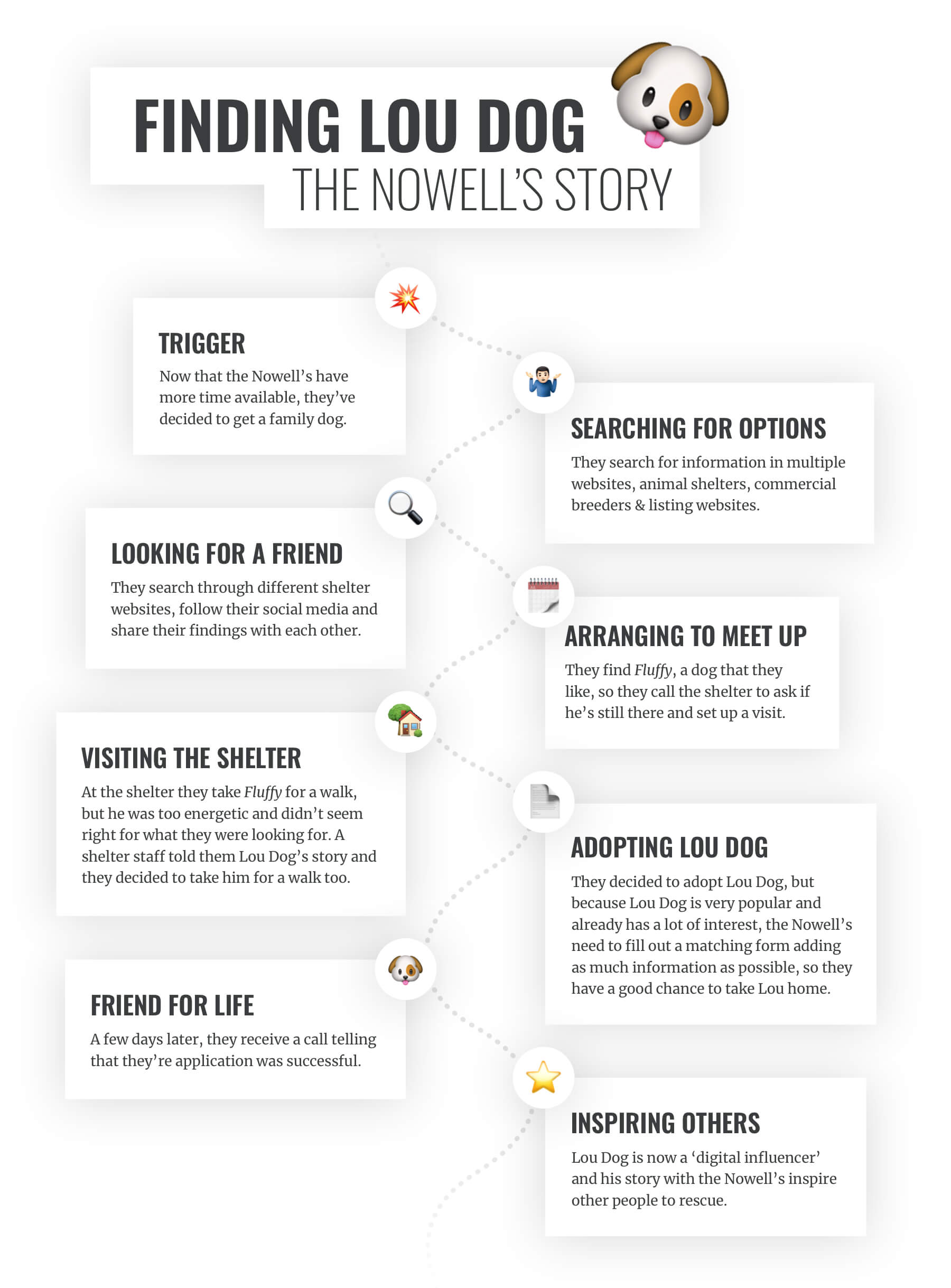
Even though there are two high level categories of users who would be involved in this product (Adopters and Shelters), I've decided to focus on the adoptors experience, due to time contraints.
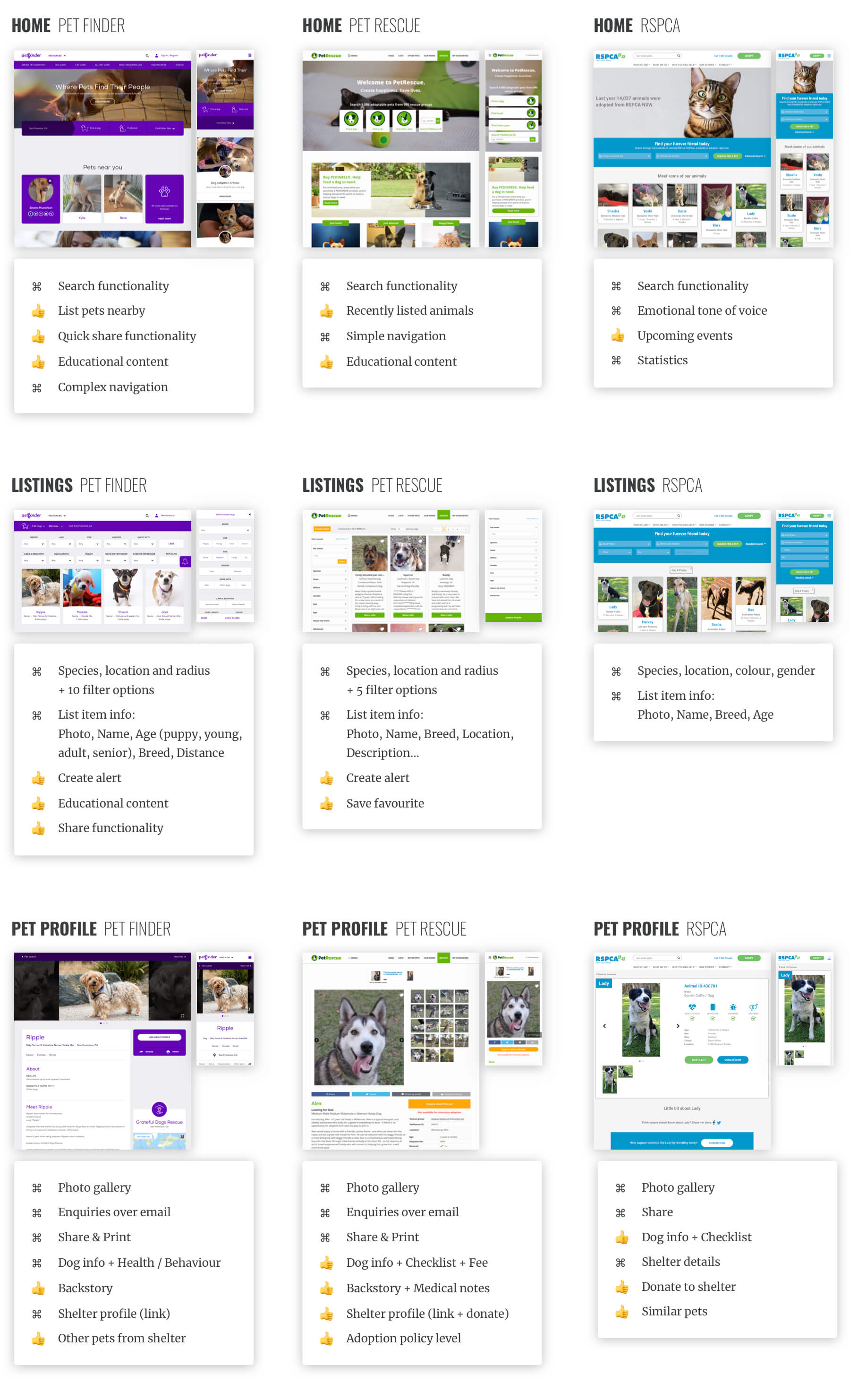

After having immersed myself and gained deeper understanding about animal abandonment and rescue issues, I took a few steps back and looked at the original challenge prompt again, but this time with a lot more context into the problem, which enabled me to add some important details to it.
Problem Statement & Design Prompt
Families who are looking for their first pet need to learn a lot about dog’s breeds, they need to consider a large number of factors about themselves and go through a long and arduous process of searching and applying before they can safely commit to adopt a pet. That's because a good match between a family’s lifestyle and an animal’s qualities is absolutely essential for a successful adoption process.
Design an experience that will inspire, educate and help families to rescue an animal, matchmaking them with abandoned animals that meet each other’s lifestyle.

At this point, the problems that needed to be solved were already defined, so I started sketching out some possible solutions. Due to the complexity of the problem statement, I broke it down into a few “How might we” questions, which helped me to focus on one challenge at a time.
In order to inspire people to rescue animals we could show sucessful rescue stories, presenting real stories might reassure people of the benefits of rescuing animals. Also need to educate adopters, this could also be tackled by showing content such as training tips or myths about adoption.
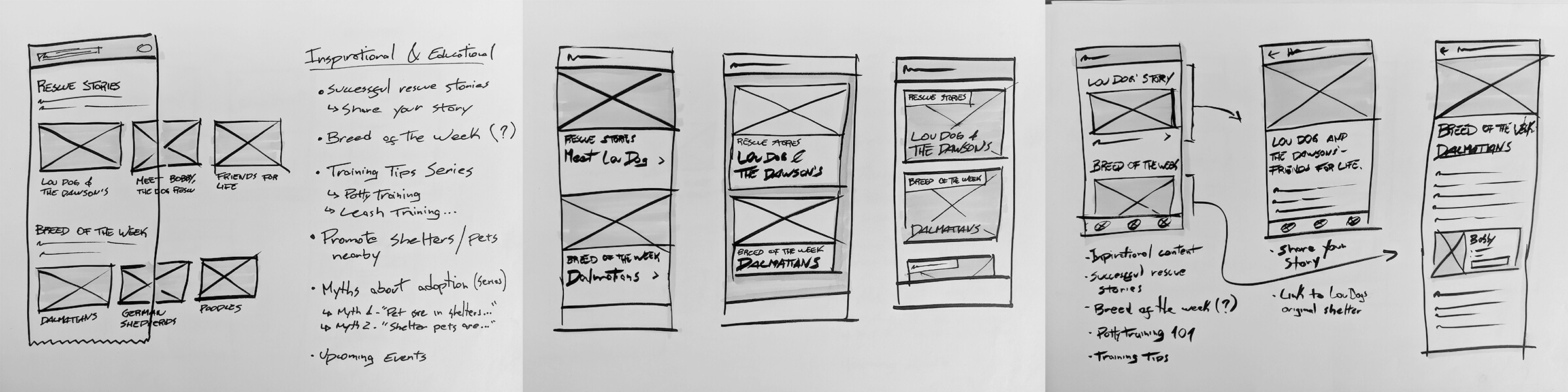
Instead of forcing users to go through the effort of searching and scanning through a list everytime they want to look for a pet, we could allow people to set their preferences and lifestyle, then we could do all the hard work of finding and matching them with pets that would suit each other. Furthermore, these “matches” could be sent through push notifications, further reducing effort and increasing efficiency.
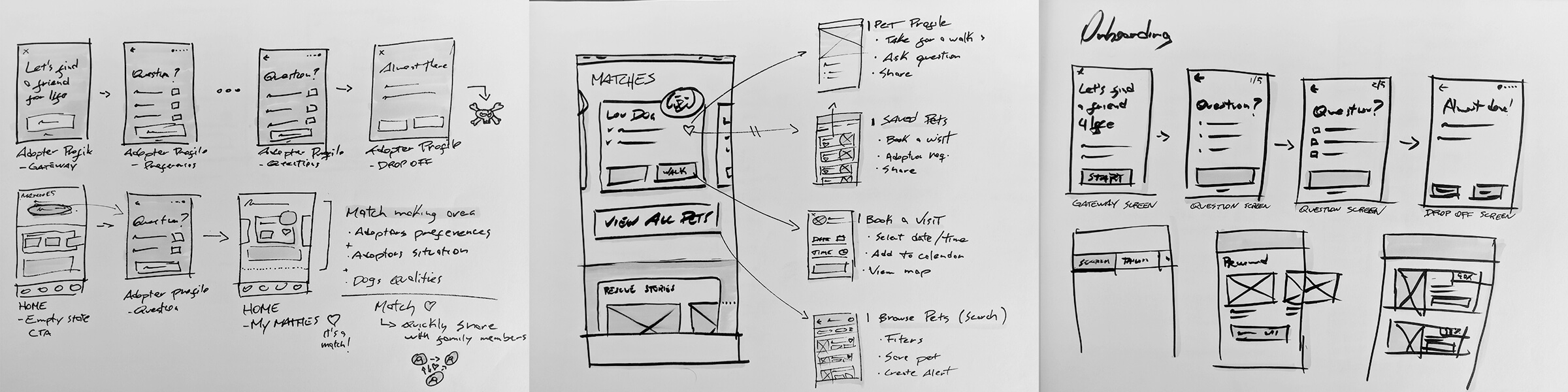
In order to help people know what to expect from an animal, we could allow shelters to enter all the general info about the dog as well as any info specific to an individual pet. Also, allowing people to send enquiries and requests to the shelters through the app might help with communication between the parties.
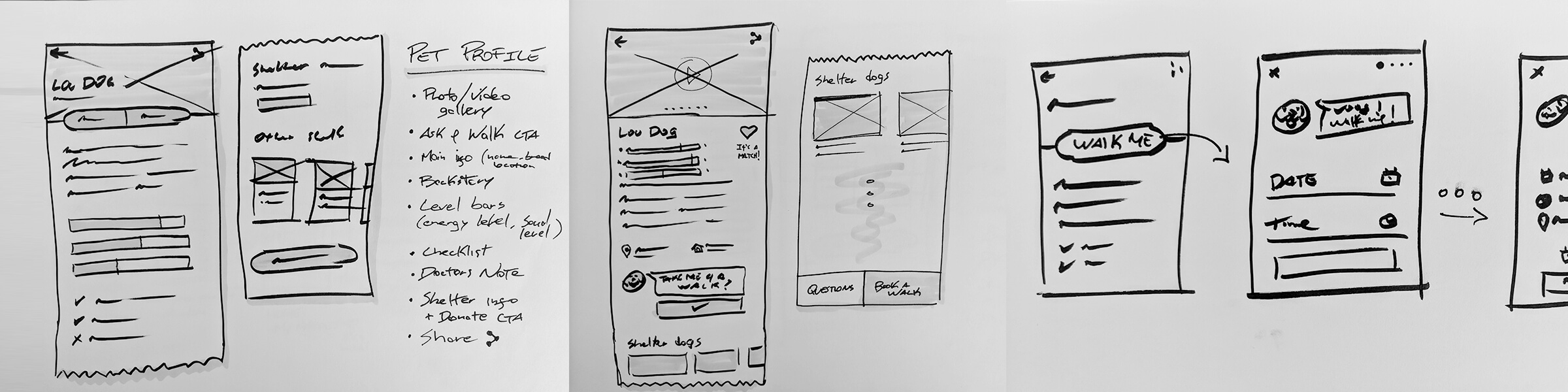
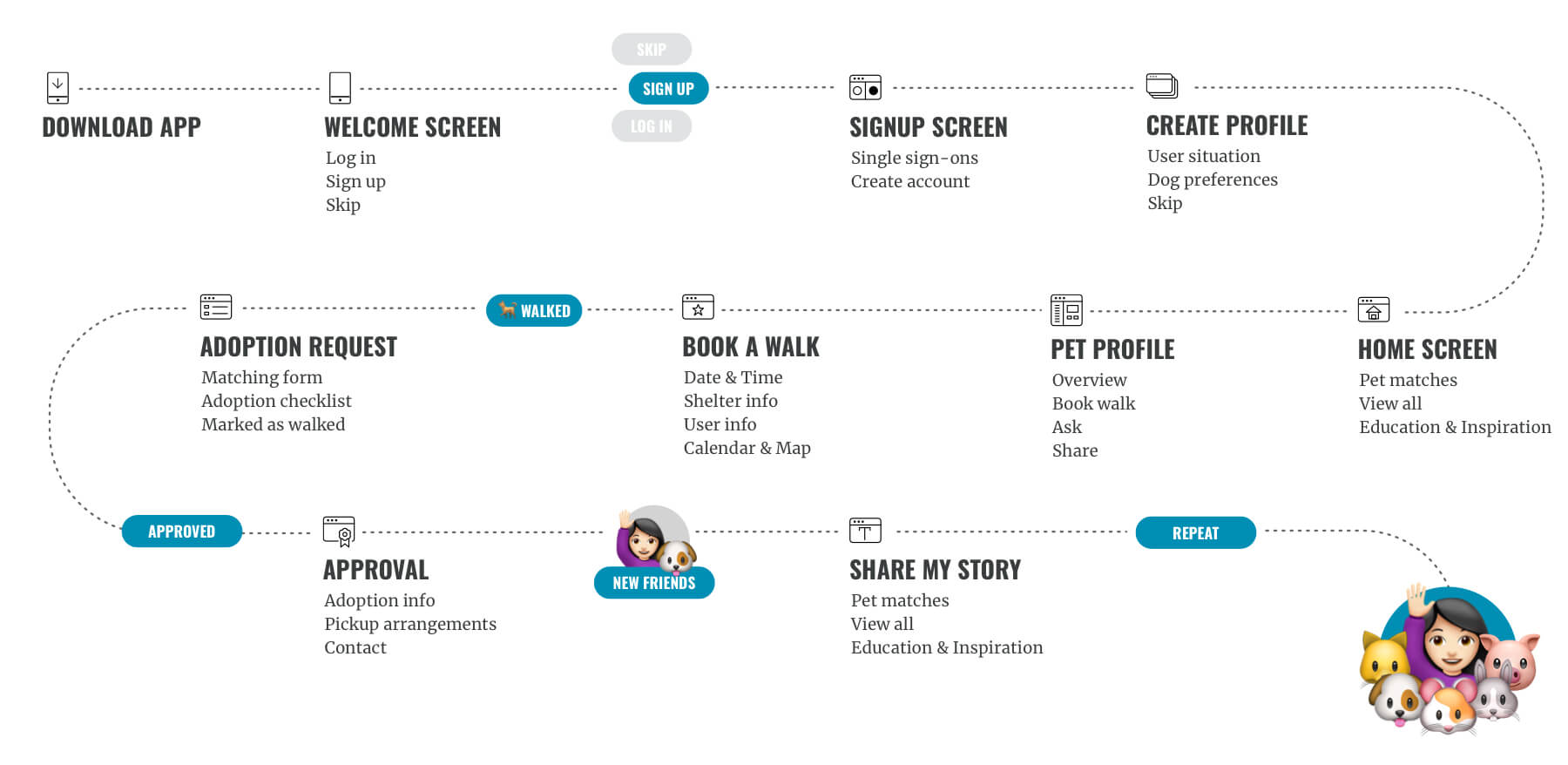
After assessing the ideas that came out of the sketching sessions, I defined which solutions had the most potential to effectively solve the problem at hand. After this, I decided to map out a possible core user flow, without adding too much details.
As the solution becomes increasingly clearer, so does the level of detail and fidelity of the artifacts. At this point I started to explore user flows in deeper detail, considering at the same time possible interactions and interfaces.
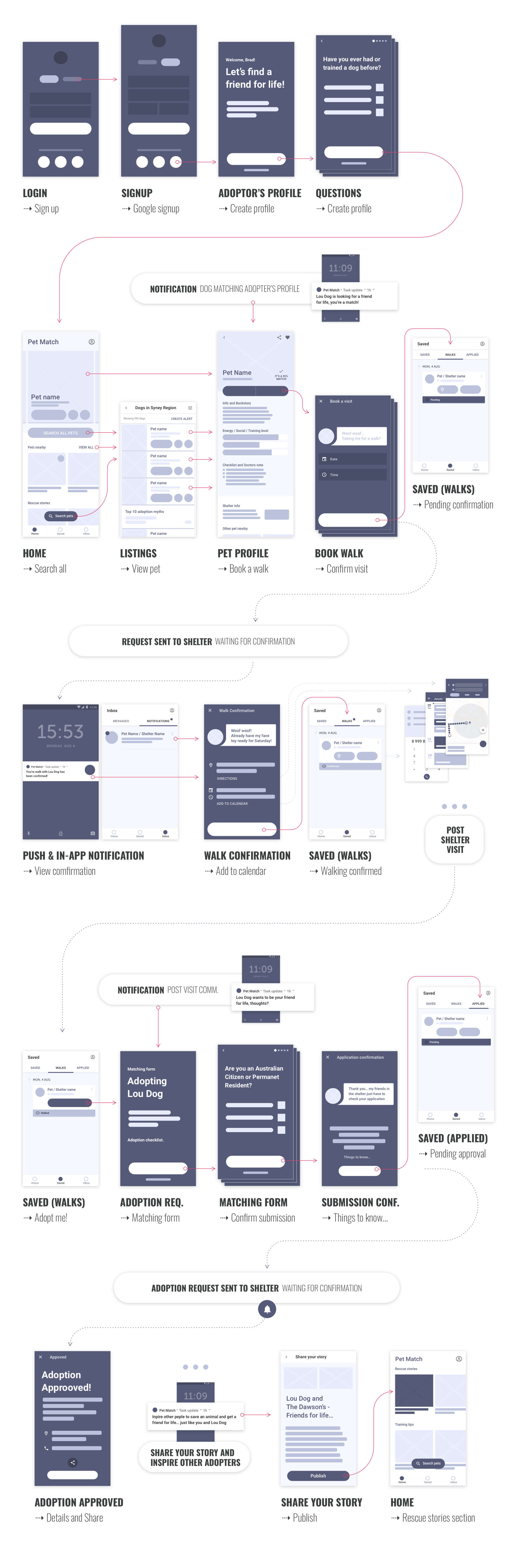
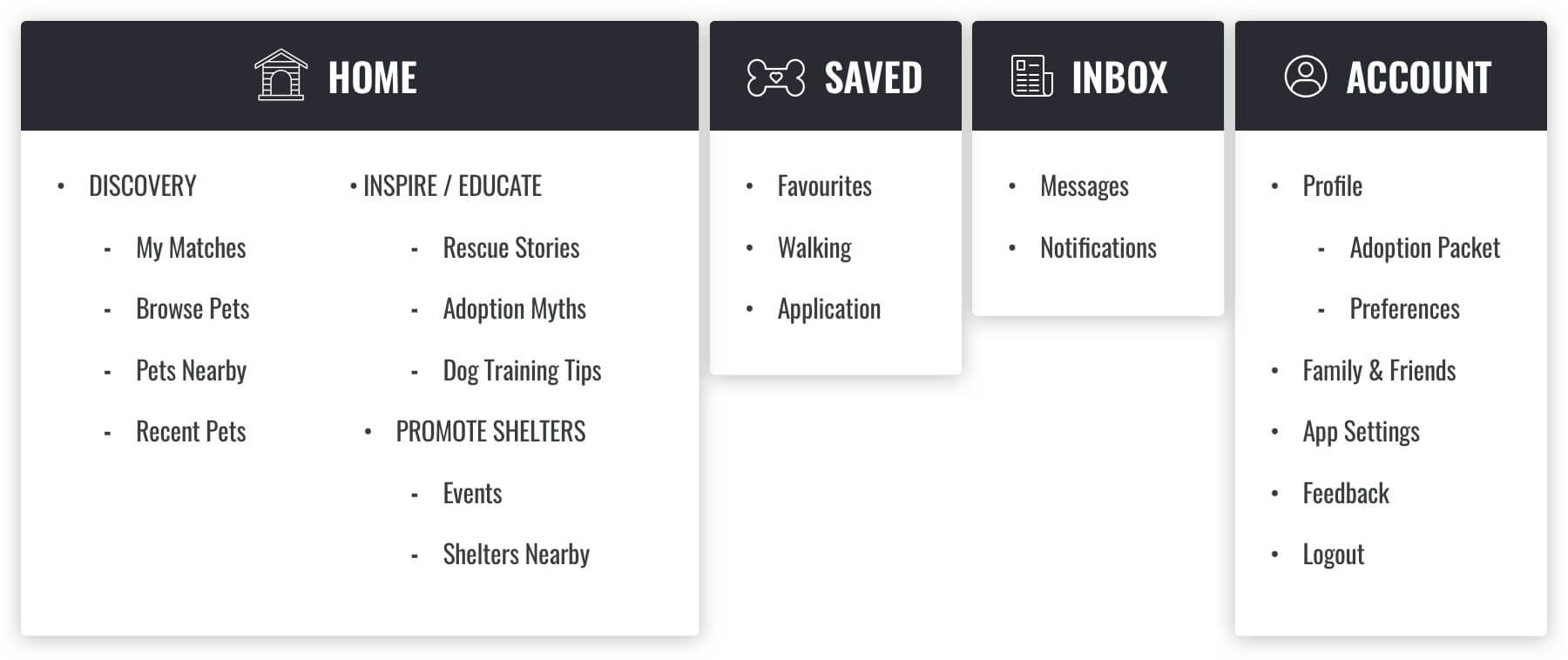
Now that I knew what the main flow would look like and what features I had to include in the product, I could define the top level navigation items as well as the content that would sit under each one of them.

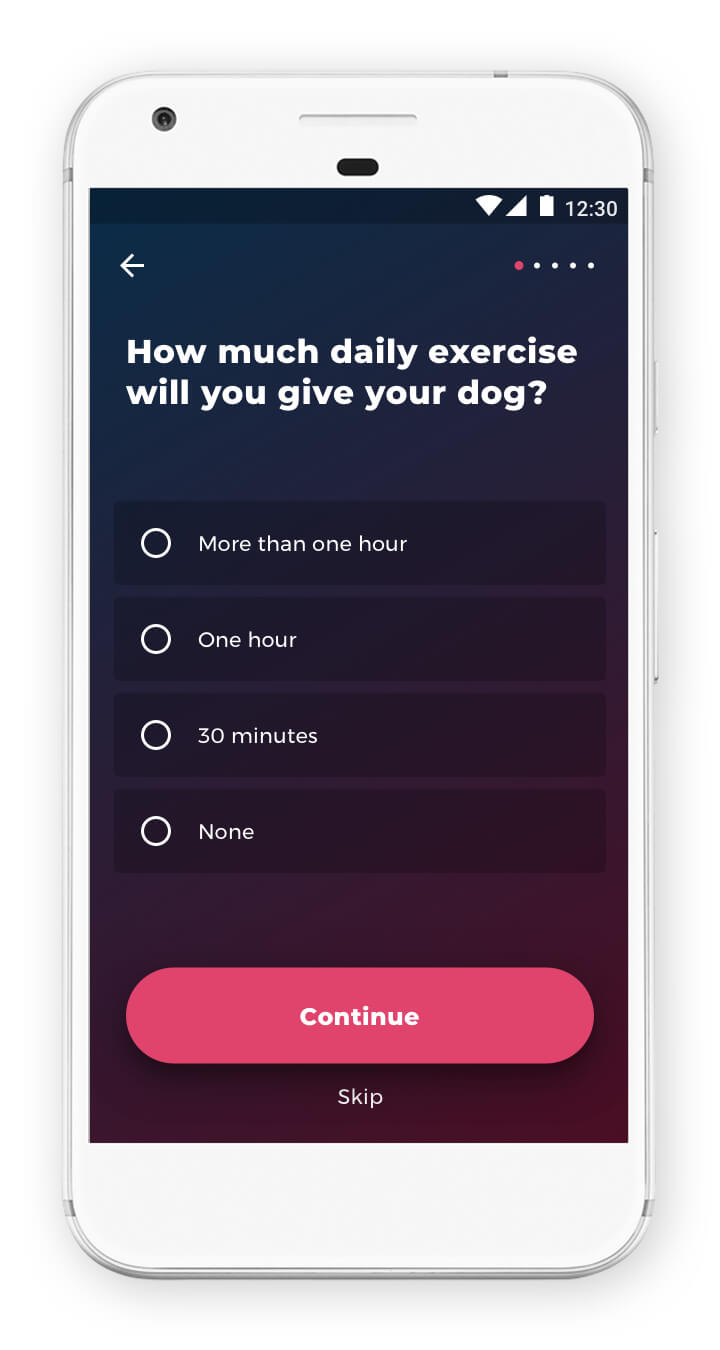
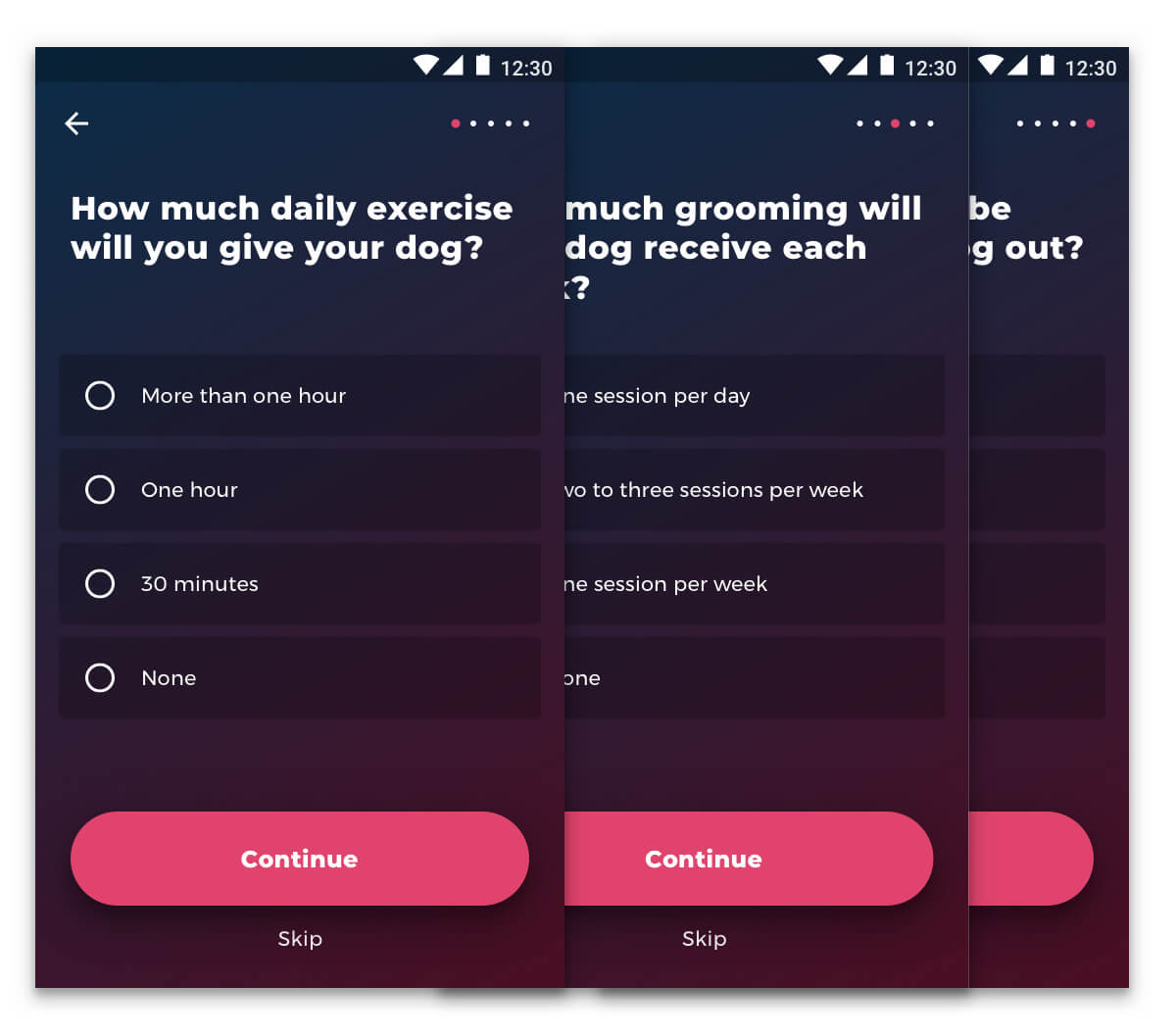
Since one of the product requirements is to effectively match a person's profile with pets that would be suitable for them. The product onboarding is focusing on acquiring the relevant information from a user that will enable the matchmaking to be made correctly. The questionnaire will take shape in a simple form that presents one question at a time in order to reduce the perceived effort that it would take to complete the flow. All answers options are presented in a form of quick input selectors in order to reduce completion time and effort.
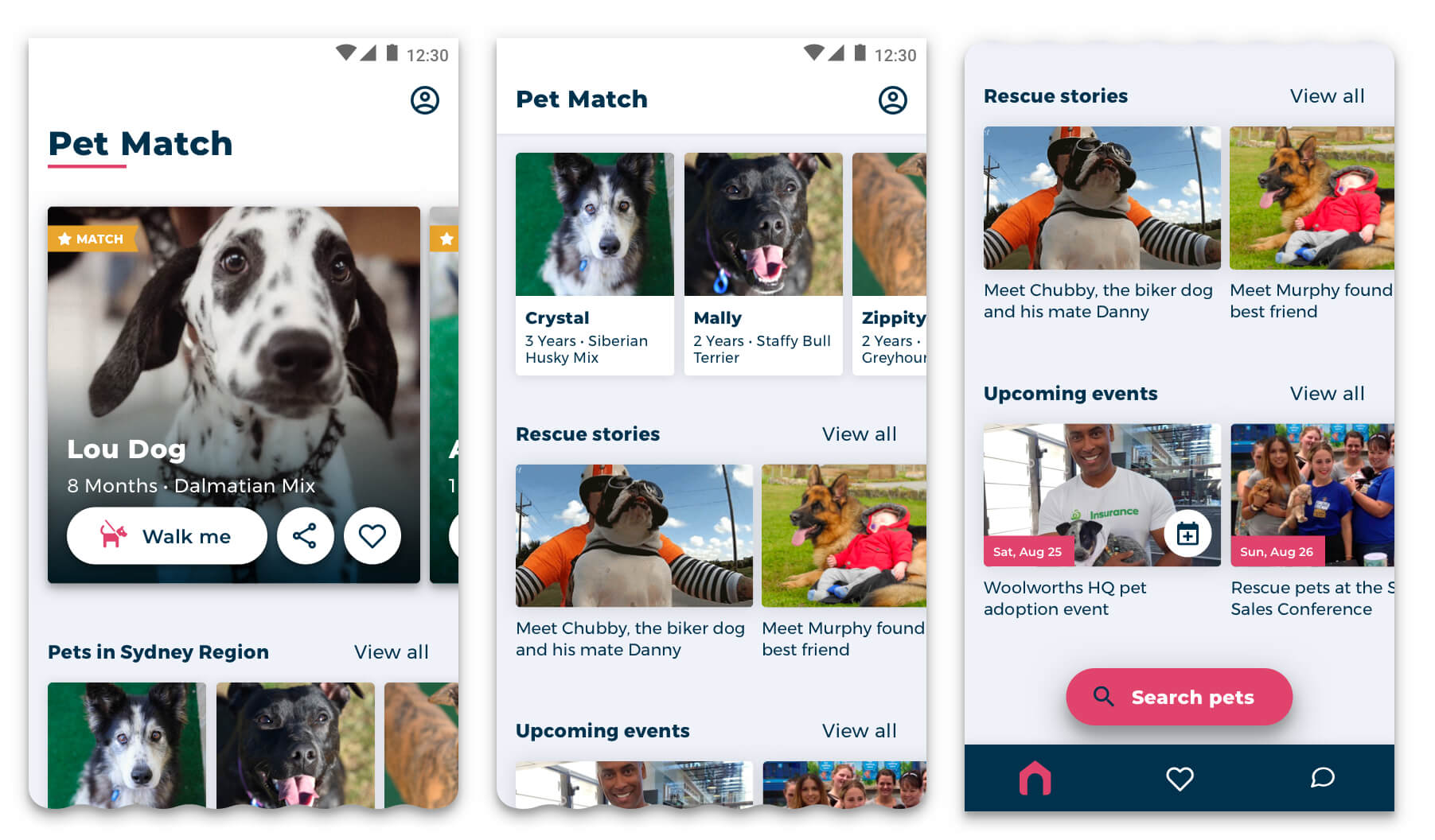
Pets discoverability is the main focus of the home screen, aiming to help adopters to effortlessly find pets that are relevant to their profile and preferences. A large portion of real estate is being dedicated to the matchmaking recommendations.
Educational content, such as articles series about training tips and breed types, is being provided in order to better inform adopters about animals. The home screen also includes a dedicated section for inspirational content, such as success rescue stories, top adoption myths and rescue events nearby.
Among some quick actions that have been placed on each listing card, the sharing action is worth mentioning due to the fact that it will help families to connect and discuss over options, while also spreading the word to other potential adopters.
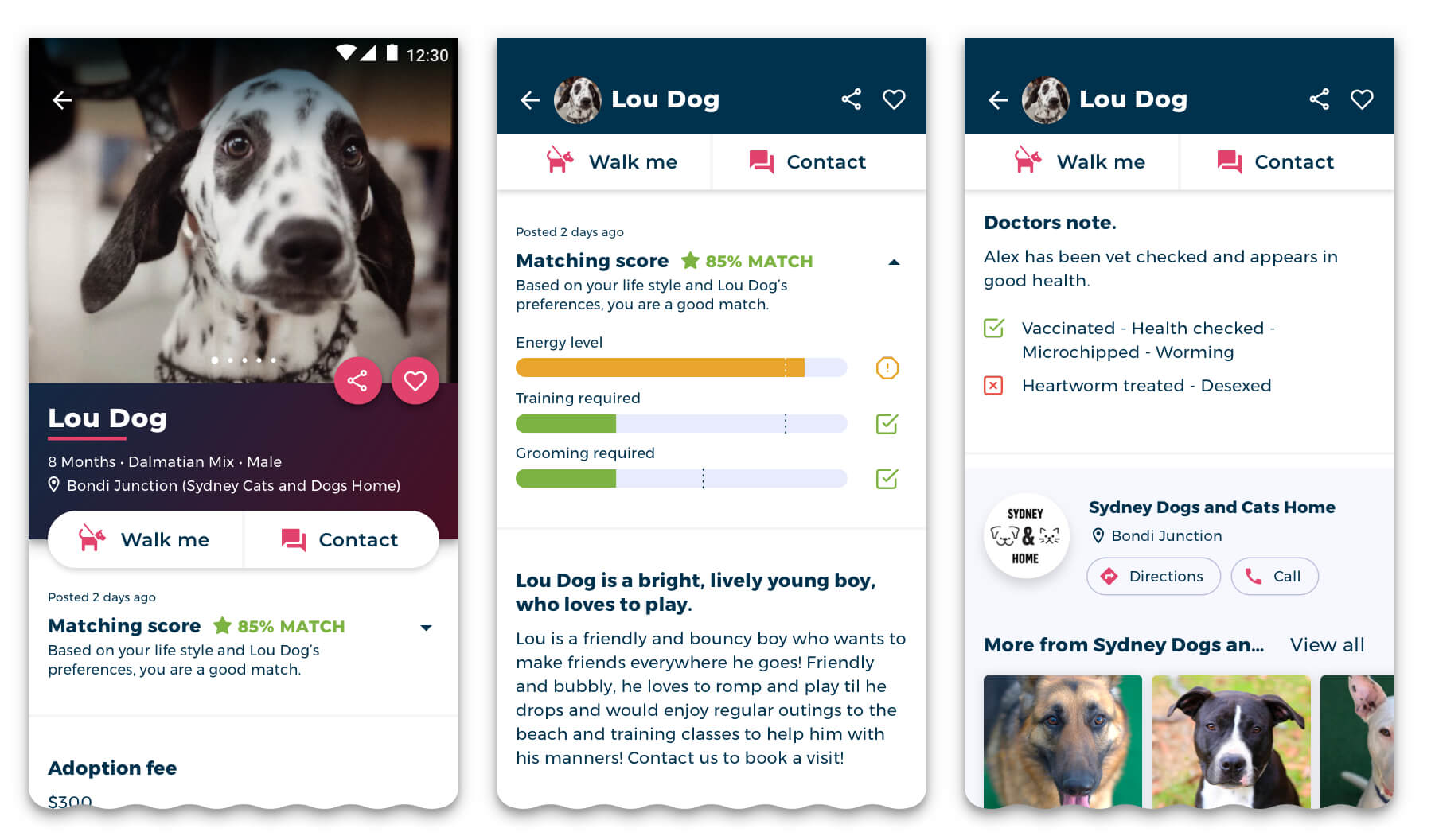
The pet profile includes all relevant information about the animal as well as an overall matching score that’s tailored to the user, based on the the information acquired during the onboarding. This matching score can be expanded and displayed in a more comprehensive manner by listing the animals qualities and visually representing where it stands in relation to the user's profile & preferences. The primary actions on this page are "Contact" and "Book a walk" followed by "Share" and "Favourite" actions which has been considered in the hierarchy of the elements in the interface. The shelter has a dedicated section that contains their contact details as well as a list of other available animals.
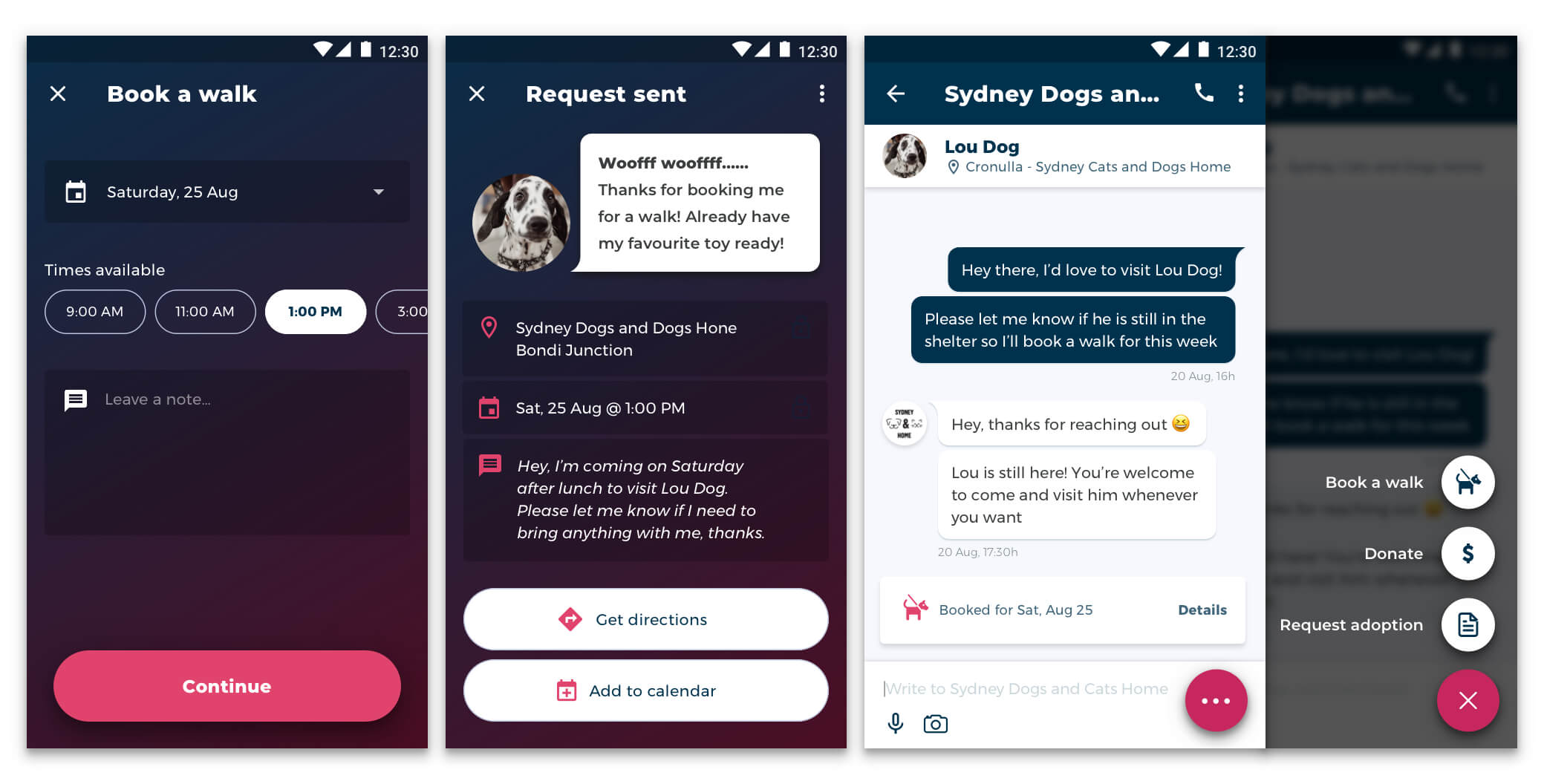
In order to facilitate the communication between an adopter and the shelter, the platform offers a channel that will allow adopters to not only send and receive messages to the shelter but it also includes a range of actions that are relevant to users considering what moment of the journey they are in. For example, if an adopter is enquiring for the first time about an animal, ‘book a walk’ would be included among the action options. On the other hand, once a walk has been booked, the options would change accordingly and include actions such as ‘reschedule your walk’.
After speaking with a few shelter staff members I took the assumption that the importance of a good match between a family’s lifestyle and an animal’s qualities is greater for dogs than other animals.
My proposed solution relies heavily on shelters adoption and content generation, this would need to be addressed when developing the shelter’s experience.
Different shelters have different adoption policies, some of them are very strict and would probably request visits and interview with potential adopters before approving adoption requests, this would have to be considered in order to support a more complex adoption policy.
Due do the nature of the product, meaning that once a person has gone through the entire conversion funnel (from signup to adoption completed), it is unlikely that they will repeat the process and adopt another animal. With that in mind, I'd suggest that user adoption and conversion are better indicators of success than user retention.
Among other key indicators, I would expect to track shelter conversions, volume of animals listed, walking & adoption request rates and NPS score.
At this point, I would start to scope out usability test sessions. In this sessions, I would define the most fundamental tasks that a user needs to perform in order to use the product and produce some prototypes for the test sessions. These test results would give me very valuable information about how the proposed solution is performing, and based on the results, I would start to iterate on the main functionalities of the product.
I would also look at the product in much deeper detail, identifying edge cases, dead-ends, different states and errors that I haven’t yet had the time to consider.
Due to the fact that the product has two types of high end users (adopters and shelters), it is vital to focus on the shelter’s experience, further understanding their needs and expectations. So, I would allocate enough time to go through the shelters experience with the same level of attention that I gave to the adoptor’s experience.
Considering integration with other products is something that I’d love to have spent more time doing, and it is also something that I believe would add a huge amount of value to the product. Integrating with Google maps, for example, and notifying users when they’re travelling to an area near a pet that matches their profile, or displaying a matching pet’s avatar on the map itself when users are passing by a shelter location. Also, integration with article publishing platforms, such as Blogger, would allow people to share their rescue stories and further expand the success stories, which would hypothetically attract other adopters to the platform.
These were the initial steps of my attempt to solve this problem, thank you for reading.